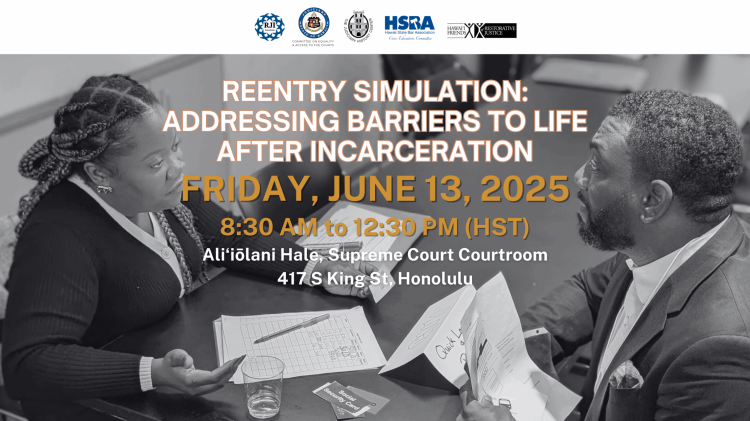
Friday, June 13, 2025
Aliʻiōlani Hale
8:30 AM to 12:30 PM (HST)
Efraín Marimón
Efraín Marimón is an Associate Teaching Professor at The Pennsylvania State University in the College of Education. Efraín develops community-embedded programs related to social justice, human rights, law, and education. He is also Director of the Restorative Justice Initiative (RJI) and the D.C. Social Justice Teaching Fellowship, and founded the Street Law Program at Penn State Law. He also conducts training on law-related education for international groups.
Efraín is the founder and director of “The Restorative Justice Initiative” (RJI). RJI is a group of faculty members, graduate students, and stakeholders dedicated to restoring and empowering incarcerated individuals by providing programming and educational opportunities in multiple correctional facilities in Pennsylvania. RJI’s interdisciplinary team has worked to create quality curricula and has several volunteer faculty members and graduate students teaching courses to incarcerated individuals in multiple correctional facilities.
Efraín is also the founder and director of the D.C. Social Justice Teaching Fellowship, a collaborative project between the College of Education’s Department of Curriculum and Instruction, the Office of Multicultural Programs, and Georgetown Law in Washington, D.C. Efraín also teaches, supervises and supports law students in the Street Law Program, where law students teach law-related lessons on the constitution and human rights to middle school students and high school students in the State College Area School District and Bellefonte Area School District.
Before working for Penn State, Efraín was a teaching fellow and adjunct professor for the Street Law Clinic at Georgetown Law. Prior to this, Efraín clerked for the Miami-Dade School Board Attorney and the General Counsel for Florida’s Department of Education. He earned his J.D. from Nova Southeastern University Law, where he graduated with honors. He received his Master of Laws (LL.M.) from Georgetown Law and is licensed to practice law in Florida. Before law school, Efraín earned his M.S.Ed. in Urban Education from the University of Pennsylvania. He taught Social Studies and Literacy in Philadelphia, worked as a Curriculum Specialist for Teach for America, and frequently led professional development for his school and school district. During his time in Philadelphia, Efraín was awarded the “Top 100 Teachers” recognition by the Philadelphia Federation of Teachers and presented a formal commendation by the School District of Philadelphia’s Superintendent for “Exemplary Community Leadership.”
Christin M. Johnson
Christin M. Johnson was appointed by Governor Ige in July 2022, and reappointed in 2024 by Governor Green, MD as the State’s first Oversight Coordinator for the Hawaiʻi Correctional System Oversight Commission. Christin has built her career in corrections reform through her oversight work in state prisons, city jails, and with local police. Born and raised in Michigan, Christin has leveraged her expert understanding of the corrections system and current policies to impact change at the individual and larger systemic levels.
Throughout her career, Christin has practiced hands-on oversight and investigation, improving the conditions and experience for incarcerated individuals and department staff alike. Previously, Christin served as the Lead Oversight Specialist in the Office of Oversight and Public Accountability (OPA) in Grand Rapids, Michigan. In this role, Christin worked closely with the City of Grand Rapids to establish the framework for an investigative analysis team. Before OPA, Christin worked as a Standards Specialist for the New York City Board of Correction, where she oversaw city jails both in the boroughs and on Rikers Island. She focused on the enhanced security and protective custody population and developed strategic plans with facility leadership aimed at improving the living conditions of people in custody and the working conditions for facility staff. Christin began her career as an Analyst with the Michigan Legislative Corrections Ombudsman, responsible for overseeing and investigating complaints in the state prison system. Christin was personally responsible for eight facilities housing more than 15,000 individuals.
Christin is a Certified Practitioner of Oversight as recognized by the National Association of Civilian Oversight of Law Enforcement (NACOLE). Christin holds a Masters in Criminal Justice with a double concentration in Analysis of Criminal Behavior and Corrections and Rehabilitation from the University of Cincinnati and a Bachelor of Science in Sociology with a concentration in Criminal Justice from Central Michigan University.
Kat Brady
Kat Brady is a Community Justice Advocate and the Coordinator of Community Alliance on Prisons (CAP), a community driven initiative that is working to create a peaceful and just society where every person is treated with dignity and respect, has enough to eat, a safe place to live, and can find meaningful work. She has been a consistent voice for justice at the Hawaiʻi State Legislature for 30 years.
In 2012, CAP authored the Department of Justice application that awarded Hawaiʻi the Justice Reinvestment Initiative and secured state funding for reentry. Through CAP, Kat has authored laws on parity for incarcerated women, reentry for people returning to their communities—Section 353H (HRS), and many bills working on sentencing and improving the conditions of confinement.
Kat has served on both the 2015 and is currently on the 2025 Penal Code Review Committee, and numerous legislative committees, bringing a community perspective and voice to these venues. She has been recognized for her reentry and social justice work by Going Home Hawaiʻi, The National Association of Social Workers, The Association of Hawaiian Civic Clubs, The Critical Criminology & Justice Collaboration, The Interfaith Alliance and, with her partner Henry Curtis, honored by Church of the Crossroads for promoting the work of Dr. Martin Luther King Jr.
Kimmy Takata
Kimmy Takata is the Reentry Oversight Specialist for the Hawaiʻi Correctional System Oversight Commission. Formerly incarcerated herself, Kimmy brings lived experience to her work, using it to advocate for more humane, effective reentry systems across Hawaiʻi. She has led peer-led initiatives focused reintegration, trauma-informed care, and community support. Kimmy holds degrees in Hawaiian Studies and Environmental Science and is currently pursuing her Master’s in Criminal Justice.
Matthew Taufetee
Matthew Taufetee was raised in a Samoan family where his father served as a pastor—something that might seem admirable from the outside. However, his early life was marked by deep pain. He and four of his siblings endured physical, mental, and spiritual abuse, leaving Matthew angry, disillusioned, and estranged from both his father and God. Seeking identity and control, he turned to gang life, where he quickly gained a reputation for violence and was eventually incarcerated for committing serious crimes.
After serving five and a half years, Matthew was released to the Laumaka Work Furlough Program in 1993. But without healing or direction, he returned to the streets—drinking heavily and rejoining gang life. Despite being married with three children, he found himself jobless, reliant on welfare, and running an illegal gambling operation to get by.
In 1996, on the brink of a parole violation, a group of men from the Men of W.A.R. ministry at Word of Life Christian Center reached out to him. Their invitation to attend church marked a turning point in his life. There, Matthew surrendered his life to Christ and began a profound journey of personal transformation. He sought reconciliation with the source of his pain—his father—and the two began to heal together after openly sharing their truths. Through that conversation, Matthew learned that his father, too, had suffered abuse and neglect in his upbringing.
In 2002, with the support of his father, Matthew opened a faith-based clean and sober living facility to support men released from prison. Since then, he has housed and mentored many individuals, offering them guidance, structure, and a path to healing through faith. In 2014, he took the courageous step of making amends with the family of one of his victims, fostering healing on both sides.
Since 2015, Matthew has been approved to provide Alcoholics Anonymous (AA) services and lead Bible studies within correctional facilities. He facilitated weekly AA meetings at Kashbox through 2024 and even welcomed the man who had killed his own brother to share a message of forgiveness—demonstrating the transformative power of grace and redemption.
Today, Matthew continues to serve weekly in several Hawaiʻi correctional institutions, including Wahiawa, OCCC, Halawa, and the juvenile detention center, offering hope, faith, and a second chance to those who need it most.
Disclaimer: While the Hawaii State Judiciary provides a venue for diverse discussion, speakers’ remarks do not represent opinions of the Judiciary.