Our Story
Friends of the Judiciary History Center of Hawaiʻi
The origins of the Judiciary History Center date back to the 1970’s. In 1976, during the last major renovation of Aliʻiōlani Hale, Chief Justice William S. Richardson appointed an advisory committee of private citizens and Judiciary personnel to oversee the building’s restoration. The advisory committee recommended an educational facility be established within Aliʻiōlani Hale to help the public better understand the role and function of the United States’ judicial branch, as well as the history and development of Hawaiʻi’s Judiciary.
Chief Justice Herman Lum appointed the first Friends board of directors as an advisory group to support the Judiciary’s development of a history center. Former Chief Justice Richardson served as the first president and many members were part of the earlier restoration committee. In 1983, the Friends of the Judiciary History Center of Hawaiʻi was established as a nonprofit 501(c)(3) organization. Act 211 of Hawaiʻi Revised Statute 6F recognizes the Friends as “the nonprofit citizen’s group organized to support the Judiciary History Center” (1990).
Today, the Friends of the Judiciary History Center of Hawaiʻi is dedicated to promoting the interests and civic empowerment of Native Hawaiians and the general public, by supporting the King Kamehameha V Judiciary History Center’s efforts to preserve, interpret, and educate about Hawaiʻi’s legal history through the lens of law, public policy, and the courts.
The Friends support the Center through contributions to historical research and publications, museum exhibitions, public programming, teacher professional development opportunities, and civic education outreach with students. In 2023, the Friends board launched the museum’s Capital Campaign to renovate and redesign the Judiciary History Center.
Your generous donation today can help the Friends support the Center’s crucial work to inform, inspire, and unite our community!
King Kamehameha V Judiciary History Center
For nearly four decades, the King Kamehameha V Judiciary History Center has served as a bridge between the Hawaiʻi State Judiciary and the public community. Located within Aliʻiōlani Hale, the Judiciary History Center is an administrative program of the State Judiciary and a permanent educational institution. The Center is one of the first museums in the United States created for and by a state judicial branch, with the purpose of exploring the history, role, and operations of the court system.
In the 1980s, federal grant awards from the National Endowment for the Humanities (NEH) to the Friends of the Judiciary History Center funded research into court cases and operations during the Hawaiian Kingdom. Historian, author, and librarian Jane Silverman led the project with Harry Ball, Professor of Sociology at the University of Hawaiʻi at Mānoa. Their research uncovered information that went into planning and developing the Center’s original exhibition, “The Social Role of the Courts,” located in JHC’s Monarchy Court Gallery. In addition to NEH, funding to complete the Center was provided by appropriations from the Hawaiʻi State Legislature and Judiciary, and contributions from the Friends.
On September 12, 1989, a formal dedication and opening ceremony was held for the Center in Aliʻiōlani Hale, with a speech given by Governor John Waiheʻe III and a blessing by Reverend Abraham Akaka. In 2000, the Judiciary History Center was renamed in honor of King Kamehameha V, the namesake and founder of Aliʻiōlani Hale.
Annual Reports

Founding Members of the Friends of JHC
- Keoni Agard
- Esther Arinaga
- Dr. Harry Ball
- Gladys A. Brandt
- Donn Carlsmith
- Suzanne Case
- Williamson B. C. Chang
- Walter Chuck
- Lester Cingcade
- Helen Cole
- Nancy Ellis
- Wallace Fujiyama
- Helen W. Gillmor
- Judge Dan Heely
- Judith Hughes
- Judge Norito Kawakami
- Tom Klobe
- Elvira Lum
- Ivan Lui-Kwan
- Judge Marjorie Manuia
- Evanita Midkiff
- Richard Miller
- Esther Mookini
- Sybil Paggett
- Yukio Naito
- Abraham Piianaia
- William S. Richardson
- Dr. Barnes Riznick
- Frederick C. Schutte
- Margaret Setliff
- Kamaile Shultz
- Jane Silverman
- Judge Toshimi Sodetani
- Elaine Takenaka
- Thurston Twigg-Smith
- Janice Wolf
Meet the Staff of JHC
Matt Mattice - Executive Director
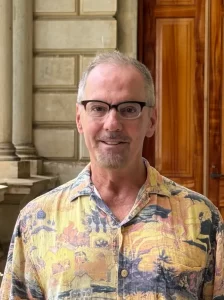
Matt Mattice
Executive Director
Matt has a Master of Education in Teaching from the University of Hawaiʻi at Mānoa. He has worked at the Center for over 30 years, beginning as an Education Specialist. As Executive Director, he worked with Chief Justice Mark E. Recktenwald to establish the Hawaiʻi State Judiciary’s Courts in the Community (CIC) program. Through CIC, the Supreme Court visits a different school district each year to conduct actual oral arguments in front of hundreds of students. He also created the Judiciary’s for-credit teacher training program. Fun fact, Matt’s great-great-grandfather was the keynote speaker for Aliʻiōlani Hale’s laying of the cornerstone ceremony in 1872. Matt holds advisory roles on local and national organizations, including the Western Museums Association, Hawaiʻi State Bar Association’s Civic Education Committee, and the Hawaiʻi Supreme Court’s Commission to Promote and Advance Civic Education.
Taisamasama K. Kaʻiminaʻauao-Eteuati - Education Director
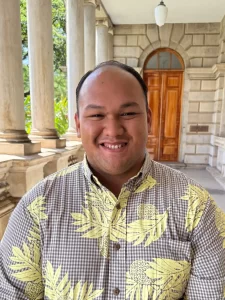
Taisamasama K. Kaʻiminaʻauao-Eteuati
Education Director
Taisamasama Kaʻiminaʻauao-Eteuati is a kupa of Anahola, Kauaʻi and is now residing in Wahiawā, Oʻahu. He is a dedicated educator and perpetual student of ʻōlelo Hawaiʻi with a background in education and community relations. Sama holds a Bachelor of Arts in ʻŌlelo Hawaiʻi from Kawaihuelani Hālau ʻŌlelo at the University of Hawaiʻi at Mānoa and two Minors in Political Science and Music.
As Education Director, Sama develops curriculum and resources that highlight Hawaiian culture and language and its inextricable role in civic engagement and law in Hawaiʻi. Sama seeks to incorporate ʻŌiwi Hawaiʻi expressions of civic engagement through mediums including mele Hawaiʻi (Hawaiian music), haʻi moʻolelo (storytelling), and many others. This can actively be observed in the various educational programs, workshops, and professional development programs that he facilitates for various school communities in Hawaiʻi and the continental U.S ranging from primary up to and through post-secondary school.
Brieanah Gouveia - Curator of Collections and Programs
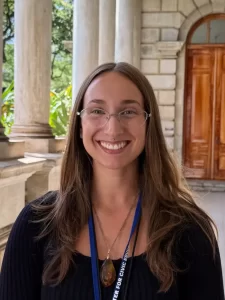
Brieanah Gouveia
Curator of Collections and Programs
Brieanah was born in Wahiawā, Waiʻanae, Oʻahu, and raised in Puʻukapu, Kohala, Hawaiʻi. A Fulbright US-UK Scholar, she holds a Master of Science in Art History from the University of Glasgow, specializing in cultural heritage law, provenance, and repatriation; and a Bachelor of Arts in Art History with a double-minor in Legal Studies and the Classics & Ancient Mediterranean World from Roanoke College.
As Curator of Collections and Programs, Brieanah manages JHC’s historic collections, museum exhibitions, public events, interns and volunteers, and institutional development. Under her leadership, JHC launched its digital archives, providing free online public access to the Judiciary’s historic collections for the first time. She also serves as the project lead for the Friends of JHC’s Capital Campaign to redesign and renovate the Judiciary History Center’s permanent exhibits.
Manaʻo Dela Cruz - Hawaiian Language Education Specialist
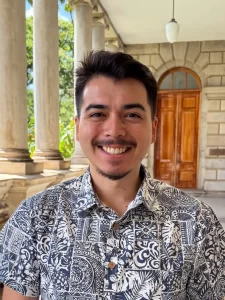
Manaʻo Dela Cruz
Hawaiian Language Education Specialist
Manaʻo hails from Kaʻohe, Hāmākuaʻāinapaliloloa, Hawaiʻikuauli. He holds a Bachelor’s in ʻŌlelo Hawaiʻi from Kawaihuelani Center for Hawaiian Language at the University of Hawaiʻi at Mānoa and a Bachelor’s in Information System Management from Northern Arizona University.
At JHC, Manaʻo manages and leads educational group visits for institutions across Hawaiʻi, the continental US, and international. Groups range from grade school to college and beyond. He facilitates learning as groups are taken through the legal history of Hawaiʻi starting with the institution of the kapu system, to Hawaiian kingdom and monarchy era, and into current representative democracy. Additionally, he assists Hawaiian language reintegration and revitalization efforts within the Judiciary by translating and creating instructional content from the Center for both professional and educational use.