Professional Development
The Center partners with local and national organizations to provide teachers with professional development opportunities.
Each year we offer programs for teachers to expand their civic education expertise and tools. One of our main opportunities is Project Citizen. Call and speak with our Education Team to learn more.
Mahalo to our sponsors and partners: The Center for Civic Education, Hawaiʻi State Bar Association, Federal Judicial Center, American Bar Association, Street Law, Hawaiʻi Department of Education, University of Hawaiʻi at Mānoa, United States District Court – District of Hawaiʻi, and Hawaiʻi Council for the Humanities.
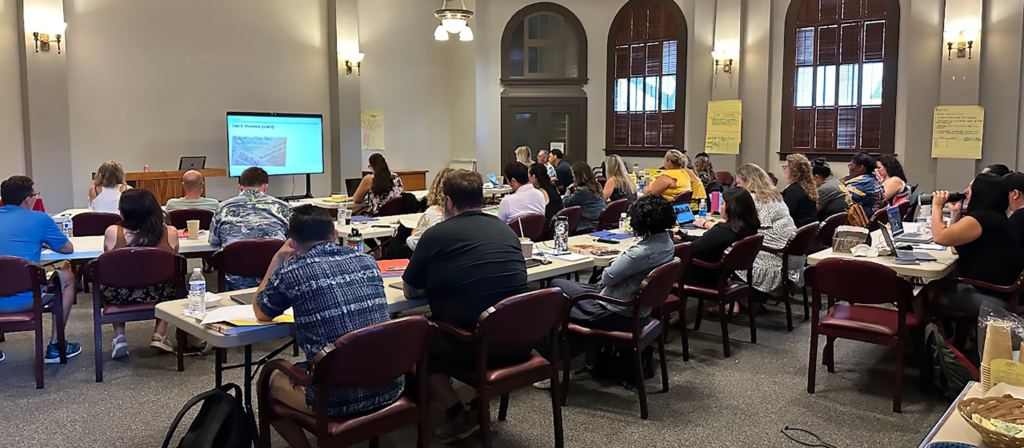
Teacher Workshop
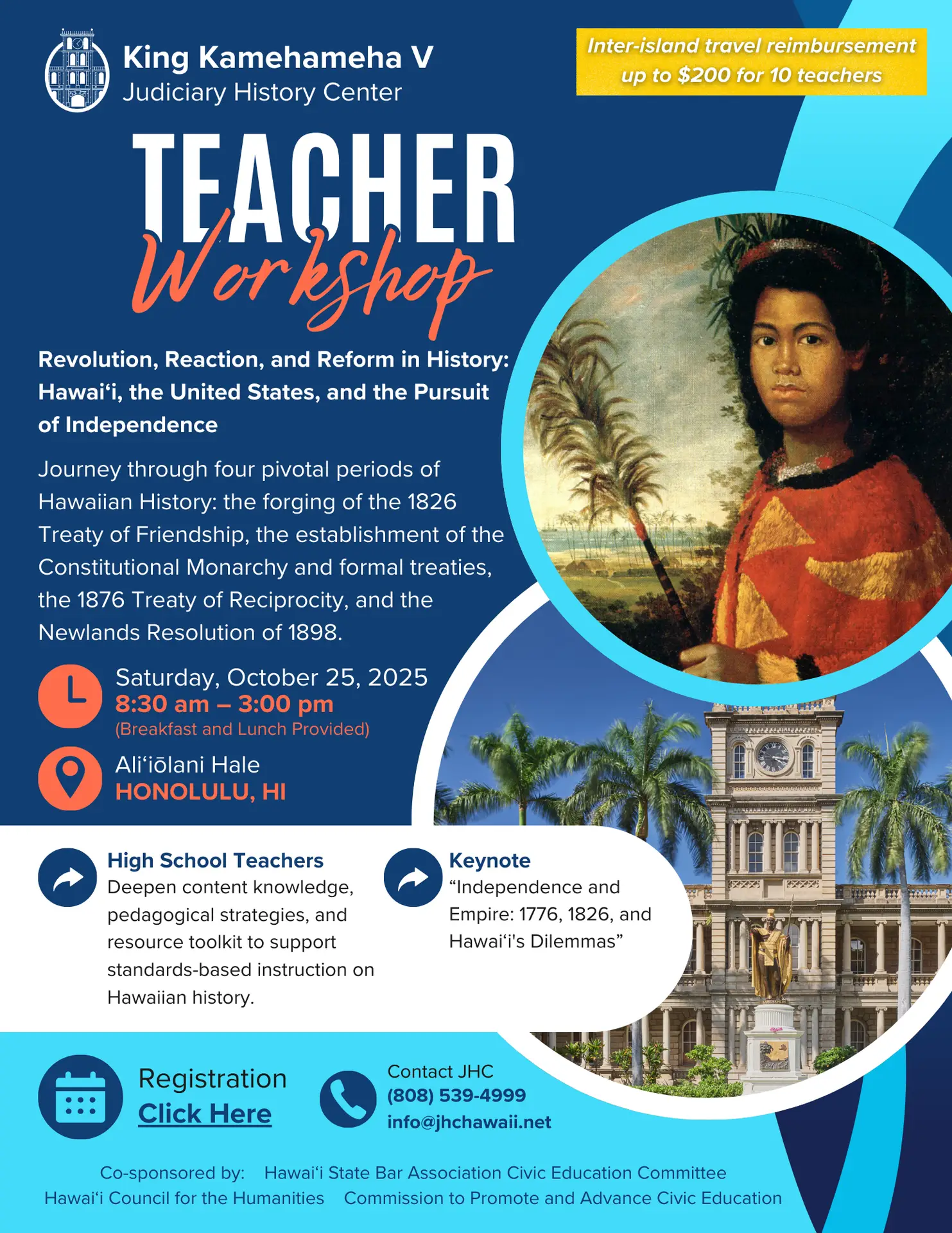
Saturday, October 25, 2025
In honor of the 200th Anniversary of the Treaty of Friendship between the United States and the Kingdom of Hawai’i, and the 100th Anniversary of the Treaty of Reciprocity, this workshop series explores the interplay between U.S. influence and Hawaiian agency and resistance, tracing the arc from early diplomacy through the Newlands Resolution, and on to revitalization and self-determination efforts.
Overview
This workshop examines the pivotal, nearly 100-year period from the unification of the Hawaiian Kingdom in 1810 to the Newlands Resolution of 1898, including the forging of the 1826 Treaty of Friendship, the creation of a constitutional monarchy, diplomatic recognition, and reciprocity, all framed through the National History Day theme of “Revolution, Reaction, and Reform.” Teachers will deepen their content knowledge, pedagogical strategies, and resource toolkit to support standards-based instruction on Hawaiian history.
Compelling Question
How did the interplay between Hawaiian agency and resistance and U.S. influence—from the 1826 Treaty of Friendship to the 1898 Newlands Resolution—frame sovereignty, identity, and rights in Hawaiʻi?
Supporting Questions
- What did “friendship” mean in the 1826 treaty, and how did both nations benefit?
- How did the 1874 Reciprocity Treaty change the balance of power between Hawai’i and the United States?
- How did Native Hawaiians and their allies resist or adapt to the increasing dominance of U.S. political, economic, and cultural power in the 19th century?
- What arguments were made for and against annexation, and whose voices were heard?
- How do Native Hawaiian perspectives on these events differ from U.S. government narratives?
Objectives
Participants will:
- Analyze the evolution of U.S.-Hawaiian relations through primary source examination of the three key treaties/resolutions
- Evaluate how the National History Day theme “Revolution, Reaction, and Reform” applies to Hawaiian history from 1826 – 1898.
- Integrate critical inquiry, Socratic Seminar, and project-based approaches for high school classrooms.
- Design standards-aligned curricular units connecting past to present sovereignty issues.
- Apply Nā Hopena Aʻo outcomes to create culturally responsive learning experiences.
- Create compelling and supporting questions that guide student investigation of this historical progression.
Standards Alignment
Hawaiian History Content Standards (Grades 6-8)
- SS.7HHK.4.12.1: Evaluate the political and economic developments leading to the overthrow of the Hawaiian Kingdom
- SS.7HHK.4.18.2: Compare and contrast perspectives of proponents and opponents of the 1893 overthrow
Modern History of Hawaiʻi (Grades 9-12)
- SS.MHH.1.19.1: Examine the long-term causes and triggering events behind the overthrow of the Hawaiian monarchy
- SS.MHH.1.19.3: Assess the argument over the legality of the annexation of Hawaiʻi
- SS.MHH.1.18.4: Analyze multiple perspectives on the overthrow and annexation
English Language Arts Standards
Middle School (6-8):
- 6/7/8.RI.8: Delineate and evaluate arguments and claims in a text
- 6/7/8.RI.9: Analyze how multiple texts address similar topics
High School (9-12):
- RI.9/10.1 and RI.11-12.1 – Cite strong and thorough textual evidence
- W.9/10.1 and W.11-12.1 – Write arguments to support claims with valid reasoning and evidence
- SL.9/10.1 and SL.11-12.1 – Initiate and participate effectively in collaborative discussions
- W.9/10.7 / W.11-12.7 – Conduct short or sustained research projects
- RI.9/10.9 – Analyze foundational documents of historical and literary significance
Nā Hopena Aʻo Integration
- Belonging: Students connect to their place and understand lineage through Hawaiian history
- Responsibility: Students examine civic responsibility and the consequences of political decisions
- Hawaiʻi: Students deepen appreciation for Hawaiian culture, history, and indigenous perspectives
Learning Opportunities
Passionate educators in California and Hawaii who teach social studies in grades 5 and 8 and are making a difference in the lives of high-need students, we are looking for you! This opportunity is for teachers new to the We the People: The Citizen and the Constitution curricular program and professional learning.
- Paid in-person week-long summer institute in Hawaii
- Free Classroom set of textbooks
- Yearlong professional learning
- Ready-to-use lessons and resources
- A stipend for completing research requirements
- Engaging pedagogy and academic content
- Gain a supportive network
- Access to inspiring scholar guest speakers
- Gain an in-depth, interactive study of the foundations and fundamental principles of the U.S. Constitution
- Develop effective problem-solving, critical-thinking, decision-making, and communication skills, which are essential for 21st-century work and civic life
- Become engaged and informed citizens who are prepared to take an active role in democracy
- Participate in 52 hours of professional learning (36 in summer institute and 16 during school-year)
- Integrate 40 hours of We the People in your classroom instruction
- Involve students in the simulated congressional hearing instructional activity
- Participate in a teacher pre- and post-test
- Administer a student pre- and post-test